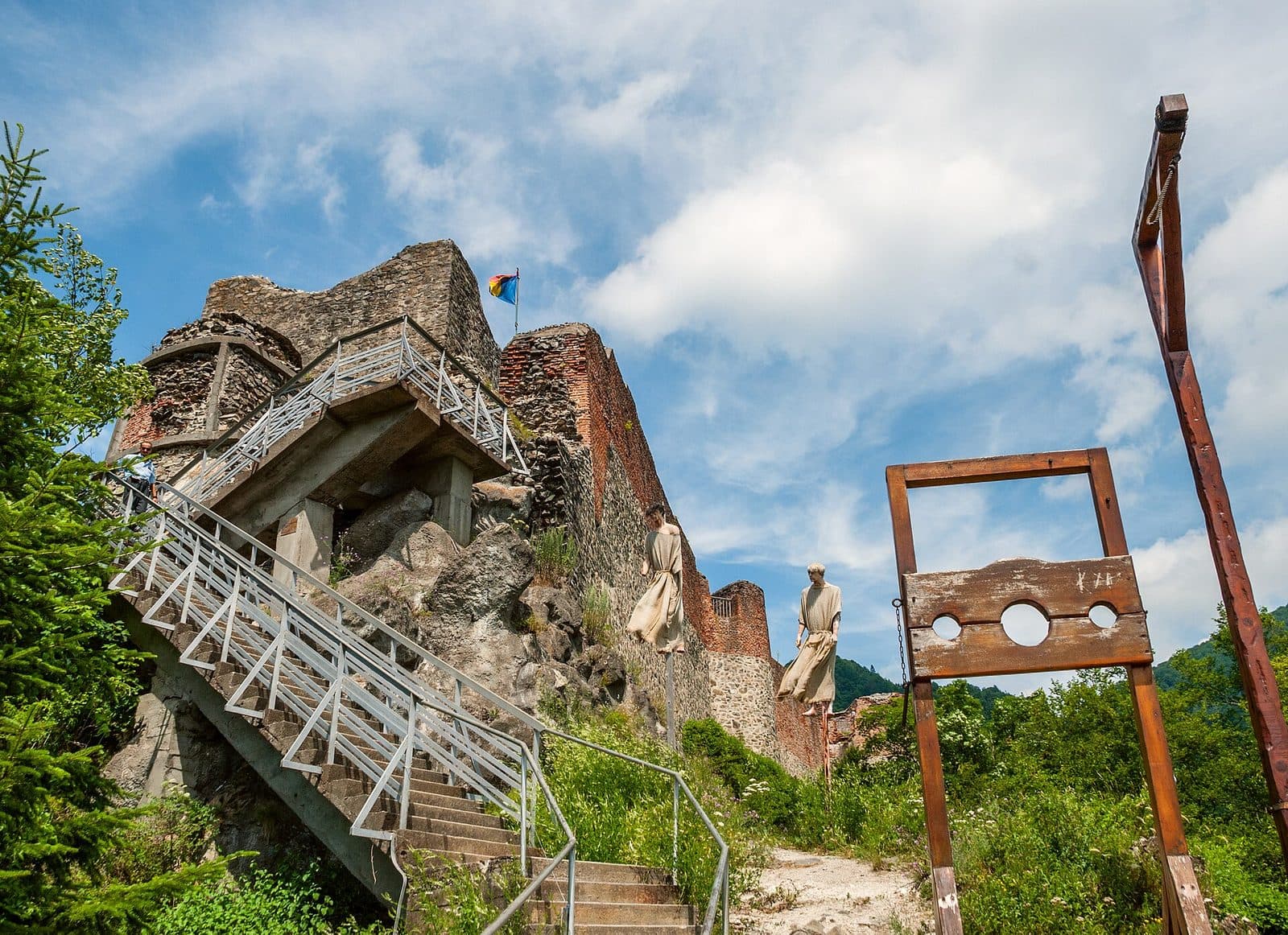
Poenari: 1,480 Steps to Dracula's Real Castle
Forget Bran — high above the Argeș gorge, guarded today by brown bears, stand the ruins Vlad the Impaler rebuilt with the hands of the nobles who betrayed his family.
While tour buses queue at Bran, the fortress Vlad III Drăculea actually held clings to a crag called Cetățuia, some 850 metres up at the mouth of the Argeș gorge. There is no road to the top — only 1,480 concrete steps zigzagging through beech forest, a thirty-to-forty-five-minute climb that ends at broken brick towers and a view straight down the valley where the Transfăgărășan begins its ascent toward the Vidraru dam and the Făgăraș peaks.
The crag was fortified by Wallachian rulers long before Vlad, but it was he who made it infamous. The Cantacuzino Chronicle, Wallachia's earliest chronicle to record his deeds, tells how the prince avenged his murdered father and brother: at an Easter feast in Târgoviște — most accounts say 1457 — he seized the boyars he blamed, impaled the old men, and marched the rest with their wives and children roughly fifty miles to the Argeș, where they hauled stone and fired brick until their festival clothes hung from them in rags. Poenari rose again on their labour.
In 1462, with Mehmed II's armies sweeping through Wallachia, legend places the fortress under Ottoman siege. The story — popularized by historians Florescu and McNally — tells of a warning arrow shot through a window by a kinsman serving in the Turkish ranks, and of Vlad's wife declaring she would rather her body rot and be eaten by the fish of the Argeș than be led into Turkish captivity, before leaping from the tower. The stream below is called Râul Doamnei, the Lady's River — though folklorists note the name carries older legends that have nothing to do with Dracula at all.
Vlad himself, the tale continues, slipped out through the mountains toward Transylvania with help from the villagers of Arefu, who mounted his horse's shoes backwards so his tracks pointed the wrong way. Local lore insists the grateful prince rewarded them with mountain pastures, the deed written on rabbit skin — a story Arefu's families have told for five centuries.
The mountain has never quite surrendered the castle. Landslides and Romania's great earthquakes tore sections of wall into the gorge before a 1969–72 consolidation added the famous steps. In 2017, a mother bear and her cubs took up residence and the site was closed; in April 2025, a 25-million-lei restoration finally reopened the fortress — for exactly two weeks, until a bear breached the new electric fence and shut it down again. Vlad's eyrie, it seems, still chooses its own guards.
“She would rather her body rot and be eaten by the fish of the Argeș than be led into captivity by the Turks.”
Curiosities & Legends
- 01The only way up is on foot: 1,480 concrete steps through beech forest, built during the 1969–72 consolidation of the ruins.
- 02The tale of boyars forced to build Poenari after the Easter purge of Târgoviște was recorded in Wallachia's own Cantacuzino Chronicle, and retold by Metropolitan Neofit I as early as 1747.
- 03The stream below the castle is named Râul Doamnei — the Lady's River — linked by legend to the leap of Vlad's wife, though folklorists have traced older, Dracula-free origins for the name.
- 04In 2017 authorities closed the citadel after a mother bear and her cubs moved in, blaming tourists' picnic leftovers, and the animals had to be relocated.
- 05After a 25-million-lei restoration co-funded by the EU, Poenari reopened on 14 April 2025 — and was closed again on 28 April, two weeks later, when a bear broke through the new electric fence.
- 06Bram Stoker never set foot in Romania: Bran trades on the Dracula novel, but Poenari is the fortress documented as Vlad III's own stronghold.
Source & further reading: Wikipedia — Poenari Castle
Experience this place yourself — woven into your transformation journey.